
A few weeks ago I ran across a brief thread on Twitter about the nearly obsolete press-on sheets of Letraset typefaces, a staple for artists and small newspapers before computers took over. As a young journalist, I doubled as a lay-out “designer” and observer at a Westminster, MD printing plant when 7000 copies of the Johns Hopkins semi-weekly News-Letter whizzed along like in the movies (and a few years later a 20,000 run of the start-up City Paper). It was rinky-dink, but that didn’t deter those involved.
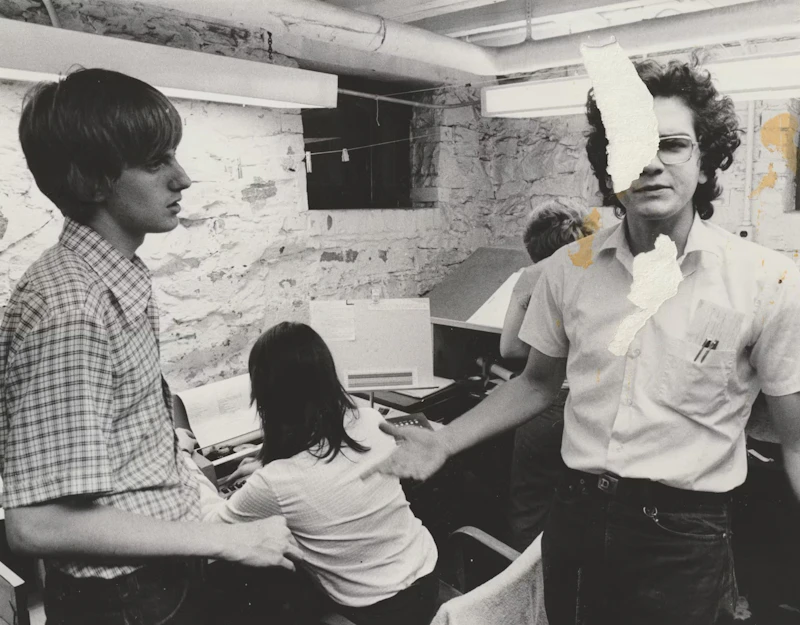
As you can see from the above picture, with Dante Landucci and Bob Fitterman discussing a problem with typesetters in the unkempt basement of the swampy N-L building (called the “Gatehouse,” incredibly, it still stands at the southern end of the Hopkins campus, even as building after building is constructed by the university, and I’d guess it’s only a matter of time before it’s razed), was a bare-bones place to work. Floods, “rats the size of cats,” no hot water and shady characters trying to break in at three a.m. were just some of the charms that were part of the bargain.
Hopkins had no journalism graduate school (or undergraduate classes), so this was a Tom Sawyer-like operation, unlike say The Daily Princetonian—once, in 1976, I disparaged that Ivy League paper and a week later received a huffy letter from its editor, who was in training for a “prestige” daily—and no one was paid except for the business manager, two “production assistants,” and the guy who drove the van to Westminster. We had a headline machine that fell apart every other week, which mechanic Dante would fix with a pencil and bubble gum; a couple of IBM Selectric typewriters, spitting out copy that was then pasted up on the “boards,” with one-line corrections affixed after space was made to accommodate the stories; and night-owl friends who dropped by with joints.
The fonts at our disposal, before an artsy comrade discovered Letraset at an advertising supply store seven blocks south on N. Charles St., were standard: Bodoni, Helvetica, Cooper Black, Cheltenham, Garamond, Times New Roman and the like. We also had Peignot (a “with it” font in the 1970s, used for the credits on The Mary Tyler Moore Show), which was popular among the staff, not least because of the jokes as the sun was about to rise. A guy would say, “Get me a strip of lower-case Peignot,” and a wiseacre would counter, “What, you talkin’ about your three-inch Peignot?” Depending on the mood, it was pretty funny. College humor, like when one night in my NL-attic office, a music critic/musician was late for a meeting. Asked about his tardiness, he said, “Sorry, I was blowing sax.” In a split-second, someone said, “Who’s Sax?”
In the fall of 1976, I stepped down from the NL editorship, and took a semester off to work in Denver at College Press Service, a “collective” of five that functioned as an Associated Press for college papers around the country. I returned to Baltimore in January, and secured a paid job at the News-Letter. In addition to helping produce paper twice a week ($3.75/hr., not bad), I inherited an ad-hoc operation called NL Hop Comp, which produced numerous campus publications and a high school newspaper from a girl’s Catholic high school nearby. (Every month, six or seven girls from the paper, awed, or disgusted, by the Gatehouse pit, would come in for two days, and unless I’m mistaken none of my colleagues perved—other than an up-and-down peek—on the ostensibly innocent girls.)
We produced the Humor Society’s parody of Rolling Stone, another well-paid job, and that was when the Letraset was first used, with particular emphasis on Shatter, a trippy font that I’d never seen. You had to be careful with Letraset sheets because they were fragile, and one flinch of a finger while rubbing a letter would fuck it up, and this material wasn’t cheap ($4 a pop). As it happened, I had a steady hand—even after several cans of National Premium—and rarely goofed with the Letraset. I was also handy with a razor blade (we didn’t have X-actos yet) and could slit a column of copy in my sleep. I took to carrying two razor blades, and a pocketknife, in my jeans, which invariably resulted in bloody fingers when reaching for a pack of matches; but while the squeamish gasped when blood trickled from my hand, I just wiped it on my pants, and went on to another round of corrections.
In the summer of 1977, in-between issues of the then-biweekly City Paper, I worked on a number of projects that put my Letraset skills to use. I bought (always charged to the client) sheets that included Frankfurter, Clarendon, Sunshine, Superstar, Pump and Neon. Although I usually worked with a partner, I did a solo production number on a 76-page pamphlet for the Chaplain’s Office—Your Guide to Hopkins—and had a ball, not least for the $400 fee. A buddy gave me the assignment, and it took three weeks: writing the copy (with editorial snipes at student government clubs), fashioning a design (rudimentary with some twists), doing the paste-up and proof-reading. The headline on the cover was all upper-case Shatter, but the Chaplain, Dr. Chester Wickwire (a noble presence on campus, with boundless energy, despite his polio that required crutches, who was at the University from 1953-1984, and instrumental in attempts to integrate Baltimore), thought it “’a bit ‘far-out, Russ’” and I switched to more palatable Frankfurter.
Otherwise, the pamphlet had almost no changes: it was completed, and I had no idea if incoming freshmen even read the text, aside from the basic information. Naturally, I was up against a deadline, and stayed up for 48 hours to fulfill my obligation. That night, relieved and exhausted, I went to a Ramones/Iggy Pop concert at Baltimore’s Civic Center—press passes!—and fell asleep 30 minutes after Iggy appeared, climbing on the amplifiers. Two hours later, a colleague—the guy who “blew sax”—said I missed a great show. Probably so, but I was glad to get the shuteye.
—Follow Russ Smith on Twitter: @MUGGER2023