
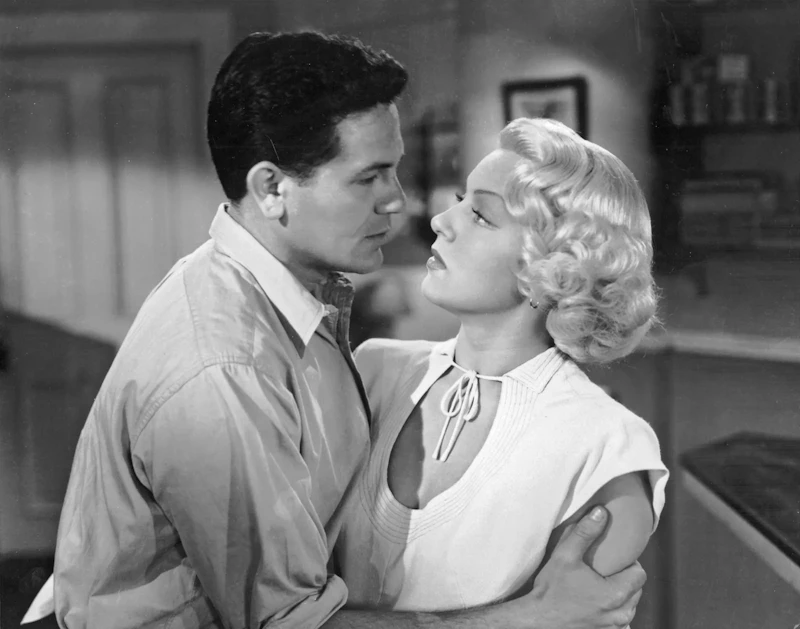
Tay Garnett’s 1946 The Postman Always Rings Twice is one of the iconic noirs, with Lana Turner—blonde hair and white wardrobe draping innocence over those hateful darting eyes—as one of the femme fatales. With its perversion of the Horatio Alger plot arc, it functions as a nasty commentary on the American dream as spur to lust, greed and murder.
But while Garnett’s version packs a lot of sleaze into its greasy roadside diner, it also substantially cleans up James M. Cain’s 1934 novel. Part of that is toning down the sex. But a big chunk is erasing the book’s racial dynamics—racial dynamics which, per the title, still ring as true in the USA now as they did almost a century ago.
The basic narrative of both book and movie is the same. Drifter Frank Chambers (John Garfield) stops at a diner in the hills outside Los Angeles. The owner, Nick (Cecil Kellaway) offers him a job, which he takes on the spot after seeing Nick’s stunning wife Cora (Turner). Cora and Nick quickly fall in love—or at least in heat. But Cora doesn’t want to go back to poverty and slinging hash. Rather than running away together, the two decide to kill Nick. After a botched attempt, they succeed. Then all they have to do is resist the temptation to rat each other out.
There are sado-masochistic undertones (and overtones) in the novel; Frank and Cora have passionate, animalistic sex after he socks her in the eye to make it look like she’s been in the fatal car accident with her husband. This is cannily written out of the film.
In its place, though, is Turner’s physical presence, which bends the movie (and Frank) around it like her white dresses hug her curves. She’s proceeded onto the screen by a dropped tube of lipstick which rolls across the diner floor towards Frank. He and the camera follow its path back entranced to Cora’s long, perfect legs, accompanied by a va-va-voom sound cue. It’s a funny sequence—or at leas until you see Cora full-on and she takes your breath away just as she takes Frank’s. He’s reeled in like a fish. Then he reels her right back by making her cross the room to take the lipstick out of his hand. Right there is the whole movie, in which they manipulate each other back and forth.
As in the book, Cora and Frank’s motivations are murky, not least to themselves. They insist they love each other, and seem to think they do, but the love’s built less on acquaintance than avarice—for sex, for money, and for a success which encompasses both. Cora keeps telling Frank that she’s going to be somebody big in business. Yet her dreams of building her own roadside diner seem indistinguishable from those of her older penny-pinching husband, who she at least intermittently despises. If a petit bourgeois lifestyle is what she wants, why is she so disgusted with Nick anyway, when he’s so good at being a petit bourgeoisie?
The movie tries to explain the marital tension by having Nick be something of a jerk. Out of the blue he announced he’s decided, without consulting her, that the couple are going to leave LA for Canada where Cora will care fulltime for Nick’s paralyzed sister. That’s a huge presumption, and you can understand why Cora gets that murderous look in her dewy eyes.
The explanation only goes so far though. In the first place, Cora tries to kill Nick before he tells her he’s going to turn her into a glorified nurse. And in the second, the belated efforts to make Nick a controlling patriarch sit oddly next to his complete lack of jealousy. He has Frank dance with Cora and sends them to the beach to frolic without him, all without any indication of suspicion. He trusts Cora, treats her with respect, and seems to see her as a partner in their business until the script realizes, too late, that she has to have some reason to want to murder him.
In the book, that reason is presented up front. It’s racism.
Nick’s last name is Smith in the movie, but in the book it’s Papadakis, and he’s frequently referred to as “the Greek.” Cora’s hatred of him has little to do with his disposition, which is unfailingly sweet. It’s his heritage, which she loathes. When she tells Frank why she prefers him to her husband, she uses obvious and vicious racist language. “You’re not greasy. Frank, do you have any idea what that means? You’re not greasy… To have to be around somebody that’s greasy and makes you sick at the stomach when he touches you.” She later adds that Nick “stinks,” and that “I can’t have no greasy Greek child, Frank. I can’t, that’s all.”
In Cain’s version, Cora and Frank are driven in part by lust and in part by greed. But they’re also driven by white status anxiety. Nick—who they see as non-white—has usurped the place of the white man by becoming a successful businessman and marrying a young white woman. Cora and Frank murder him to restore the rightful status quo. Frank and Cora are lazy, ruthless, vindictive, and sadistic, but they’re white, and that’s supposed to guarantee them money, love, and the happy normal life promised them by Hollywood.
In this case, Hollywood doesn’t give them the happy normal life at all. It instead righteously punishes them for being greedy concupiscent murderers. By removing Nick’s racial identity, though, the film deliberately avoids punishing them for being racist. It also removes Cain’s implication that the American mythos of meritocratic success is corrupted at its core by white supremacy. Frank and Cora believe white people are the only ones allowed to succeed. If that dictum’s violated, economic rage, sexual jealousy and murderous violence follow.
This ugly dynamic has defined America for its entire history. A Black man became president, and white people—like Cora and Frank before them—responded with an orgy of self-destructive rage. Hollywood is rarely willing to confront such truths now and certainly wasn’t in 1946. So Nick’s turned white in to erase whiteness; without racial difference, you can’t see that Frank and Cora’s murder is an act committed by white people as white people in the name of enforcing white supremacy. The murder in the movie is just an example of bad people doing bad things—or, perhaps, an indication that the American rat race can lead weak men to do bad things, especially if they’re confronted with a woman who looks like Lana Turner.
The Postman Always Rings Twice deserves its status as a film classic. It’s also a striking case study of how Code-era Hollywood sanitized and scrubbed potentially anti-racist messaging. Better to have no motive for murder at all, the studios figured, than to acknowledge, as James M. Cain did, that racism exists and is soaked in blood. Cora and Frank go to their deaths because they’re guilty. But the innocence of whiteness is carefully preserved.