
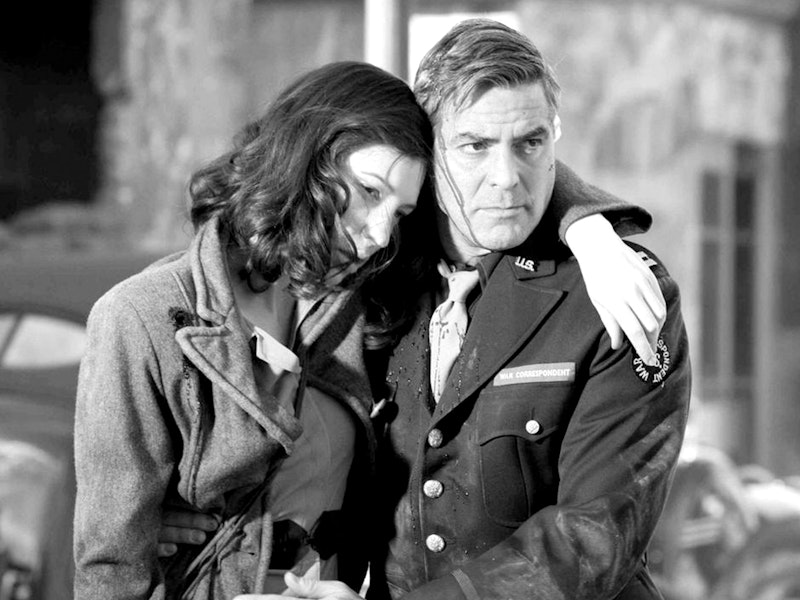
The movie poster for Steven Soderbergh’s The Good German (2006) is a homage to the famous poster for Casablanca. The film, though, isn’t a Casablanca riff. On the contrary, it’s the anti-Casablanca. Rather than a movie about a cynical American hero with a heart of gold who learns to fight fascism, it’s about a naïve American, the material of whose heart turns out to be irrelevant in a post-war world where fascism, supposedly defeated, stains the world.
The American in question is Jake Geismer (George Clooney), a maybe Jewish correspondent for The New Republic who goes to Potsdam to report on the postwar conference there. His driver, Tully (Tobey Maguire) an eager boy who babbles about apple pie, is, it turns out, sleeping with Jake’s former girlfriend Lena Brandt (Cate Blanchett). Lena’s former, and perhaps dead husband, Emil Brandt (Christian Oliver) has sensitive information about the Nazi rocket program. He’s pursued by Americans and Russians alike across a moody Berlin of shadowy interiors, sex-soaked nightclubs, and public thoroughfares whose innocence is fractured by meaningful glances and too casual passersby.
Soderbergh shot the film in black and white, evoking classic Hollywood. The choice has misled many critics into seeing the movie as a shallow exercise in stylish nostalgia. But as with the Casablanca nods, period choices aren’t just form, but ironic, and bitter, comment. Soderbergh’s mashing up two genres to puncture Hollywood’s complacent views of American heroism and virtue.
The World War II film is at the heart of the story the United States tells about itself and its righteousness. Soderbergh uses noir to tarnish that story and that heart with the gray shadows of moral ambiguity, greed, and deceit.
The cheerful, baby-faced all-American boy who chatters with open bonhomie about American pie is a black-marketer, violent thug, and sexual sadist motivated by greed and wounded narcissism. The Jewish victim’s a collaborator and murderer whose self-loathing can’t compete with a vicious instinct for self-preservation. The wide-eyed manly hero is the film’s biggest dupe, from the moment when he gets his pocket picked through seemingly endless beatdowns to his own grotesque moral compromise fueled by lust and delusion.
And as for the heroic American army, all its familiar members—the gruff plain-talking Colonel; the clear-eyed honorable military prosecutor; the staunch, silent lieutenant—turn their talents and idealism not to holding Nazis accountable, but to covering up their crimes in the name of geopolitical power. “I’m the first to recognize there were excesses in the Nazi leadership. But…” a hearty Congressman announces, before launching into exactly the kind of excuses you’d expect to hear from the leader of a country which would eventually give us Donald Trump.
Clooney and Blanchett are perfectly cast—his open pleading eyes and bluff honesty creating a kind of queasy anti-chemistry with her sensual angularity and knowing contempt. Soderbergh’s canny in his use of historical detail to evoke a city, a continent, and a world of cruelty in which everyone’s implicated. An American soldier tosses antisemitic slurs at a legless man who was the subject of Nazi medical experiments. There are flashbacks to the little-mentioned mass rape of German women by the Russian army—women who often have to become sex workers for American soldiers in a Berlin under occupation.
In contrast to popular Hollywood schmaltz like Schindler’s List, in which the Holocaust has uplifting moral lessons for us all, in The Good German atrocities and horrors lead, not to redemption, but to squalor. “The whole city spread its legs for you,” Tully muses cheerfully as he contemplates the power and money that’s come to him by being a victorious American. “Certainly, I would never wish for all those millions of people to die; but, the war was the best thing that ever happened to me.”
The Good German isn’t shy about its message; every character’s corrupt, every love’s misguided, every motive’s impure, and America’s dreams of bombs and money offer little hope for a different future. But critics—positive and negative—largely missed the point, either deriding the movie for lacking fully-developed characters or praising it for its pretty visuals. They’re oblivious to the way that the attractive surface is there to mask putrefying depths, or to the fact that the characters lack depth not because their stock, but because this is a world in which everyone is petty and shallow.
It’s no wonder that Soderbergh has often turned his talents to genre exercises when his best work is greeted with such incomprehension and indifference. Don’t let the callow reviews deter you though—this is one of the great World War II films, precisely because it turns the genre against itself and against the American self-aggrandizement that has generally been its purpose. Soderbergh’s filmography is uneven, but there are a few masterpieces, and this is one of them.
The climactic chase scene, with a wounded man desperately pushing through a throng of cheering Americans as he’s pursued by a German bent on doing the United States’ dirty work, is virtuosic both in its claustrophobic panic and bleak symbolism. The United States didn’t come out of its victory morally renewed. It just became more powerful. After genocide, everyone, and everything, is worse.