
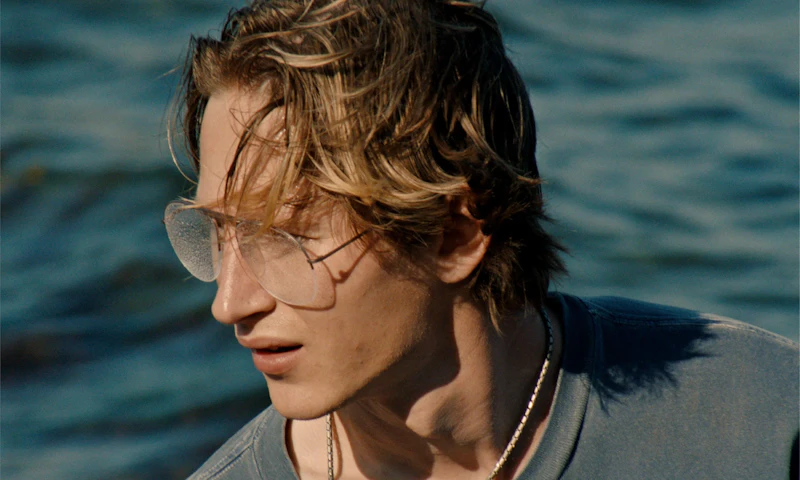
There’s a moment right past the midpoint of Blue Heron, where after increasingly untenable behavior from the elder brother character, Jeremy (Edik Beddoes), a social worker invited by the parents comes to the family home to begin the process of taking him away. This brief melodrama is something of a betrayal to the quieter film director Sophy Romvari had been building for her feature debut, one which suddenly, despite the emotional clarity of what’s going on, Romvari feels the need to heavy her otherwise subtle hand.
It’s a break with the confidence that otherwise marks the film up to this point, where Romvari finds no more use in working towards recreation. “I just don’t think I could’ve sustained the film in the first half,” Romvari told Screen Slate. “I think the point at which it cuts to the present is exactly when I exhausted that form. That hinge is where I was actually titillated artistically.”
It’s this switch, where the film suddenly moves from the 1990s to the present, and Romvari’s stand-in Sasha is now, too, a grown woman and a filmmaker (played by Amy Zimmer). This mode will be familiar to anyone who has seen Romvari’s rightly acclaimed shortform work, with Sasha using documentary as a way to mull over and process memory. Here Sasha shows a group of child psychologists her brother’s file, trying to figure out if it was mishandled then and how they could do it differently now. I’ve seen some mixed reactions to this turn, but have heard less talk about the conclusion it leads us to, where Romvari shows her hand by, bravely, showing that she hasn’t been able to resolve this herself.
The final act of the film has Sasha entering a temporal loop, where her investigation leads her back in time as she takes the place of the social worker taking Jeremy away. She observes his room: dark, with just a slit of natural light cutting through the concrete, and the walls coated in hand-colored maps. These are details which are real, tangible, factual, but they can only bring us so close to someone that’s not there, who, to Sasha, to Romvari, was never really “there.”
It’s telling that when Sasha has the opportunity to talk with Jeremy—while all the siblings are sitting watching cartoons—she instead goes and observes herself. It’s a heartbreaking moment taken right out of Robert Altman’s adaptation of Fool for Love, and Zimmer’s restrained tears sell it as she whispers something into the ear of younger Sasha (Eylul Guven) and makes her laugh. This is a moment of radical honesty from Romvari: the film was always about her. This in and of itself isn’t strange. Plenty of filmmakers, like Bill Douglas or Terence Davies have turned their childhoods into a form of poetry from their younger selves' perspectives. What’s more difficult to square is Romvari’s attempt to make both a film about her brother and herself.
A friend brought up James Tate’s poem “The Lost Pilot,” about his father who died flying in WWII, when we were talking about our mutual ambivalence towards Blue Heron. Tate believed he had to get out of the way, lest it haunt all of his work for the rest of his life. I cann’t help but think of Guy Maddin’s My Winnipeg, a semi-autobiographical film he made well into his maturity as a filmmaker, which is simultaneously an essay about his hometown and a recreation of his childhood, in particular how he and his siblings clashed with their mother. It’s the kind of film that I don’t think Maddin could’ve pulled off any earlier in his career and, I think Blue Heron might fit similar for Romvari. I do think Tate’s stance rings true—that this ghost of Romvari’s childhood would loom over her work until she exorcised it—but I think her focus in doing just that has gotten her lost in the inquiry.
What I’m left with at the end is not the haunting of an unknowable person, but the emptiness of living for 90 minutes with people who don’t seem to try. During the sequence where the parents postulate why Jeremy is the way he is, they think it could have to do with something as simple as bullying, whether for his glasses or his hint of a Hungarian accent. These come off as excuses to not pry at something more unseen (perhaps the secret lies with surveillance, whether from the neighbors with whom the immigrant family feels they have to conform, or through the camera that Sasha grows up holding), something that would force these characters that purport powerlessness to confront themselves.
Romvari might be calling bullshit on the parents, too, with a camera pan into the refracted edges of a mirror, citing the horrifying, world-shattering argument at the center of Jon Jost’s The Bed You Sleep In, where a man denies to his wife that he sexually abused their daughter. Romvari’s film, though, never goes for as confrontational or informative of a revelation, instead letting the parents—and herself—off from as scrutinous of an examination that they give to Jeremy. It leaves the world of the film feeling bizarrely empty, despite all the life Romvari breathes into it at every turn, like how great the child performances are on the two other younger brothers (Liam Serg and Preston Drabble), despite the fact they’re barely characterized at all (Dan Sallitt notes as much in his brief Letterboxd entry).
The best thing I can say about Blue Heron is I’m still thinking about it, even if it’s only because the tender emotions have faded and my frustrations have grown. It’s a film I wish had cut the scalpel past the top of the flesh, one that was willing to turn its blade on what it sees as the bystanders as much as the perpetrator. It’s a film I wish was different, as I’m sure Romvari wishes that her brother’s life had been different, too. But that’s in the past, it’s impossible to change now. Ultimately, that’s why when Sasha goes into the room she doesn’t talk to Jeremy; Jeremy’s already a ghost when she gets there, he’s gone when she looks back. He’s someone who appears as a passenger in her life, someone she carries with her always in a way that’s more painful than having known him; she lives with the pain of never being able to know him at all. Now, all she can do is talk to us by talking to herself, in hopes that maybe, at least, we can understand.