
His genre-defining roles in Top Gun, Days of Thunder, and Mission: Impossible makes it seem like Tom Cruise was always known as the action star he is today. It’s easy to forget that instead of a death-defier, Cruise’s latent energy was first unleashed to the top of the box office not as a pilot, a driver, or a spy, but as a yuppie.
Cruise owes his career to Risky Business, becoming the face of a young new money generation that climbed its way to the top through sheer force of will (it’s no wonder that Cruise’s later work would be a distillate of this force). What makes Cruise’s role as Joel Goodson so interesting isn’t just how vivid and physically dynamic a performer he is, but how Cruise himself gets so caught up in his own whirlwind that when moments of reflection come up, he’s as taken off-guard by it as we are. When the fun’s over and Joel’s parents finally make it back home, the rowdy Gen Xers have made sure to clean up the Goodson house to the best of their ability, so as their more frivolous hustling and partying doesn’t effect these young social climbers’ ability to keep rising up the ladder. Joel’s mother, though, notices a crack in her glass egg on the mantel, a crack that Joel couldn’t see. There’s something lurking underneath the promise of wealth and nuclear family and country club memberships.
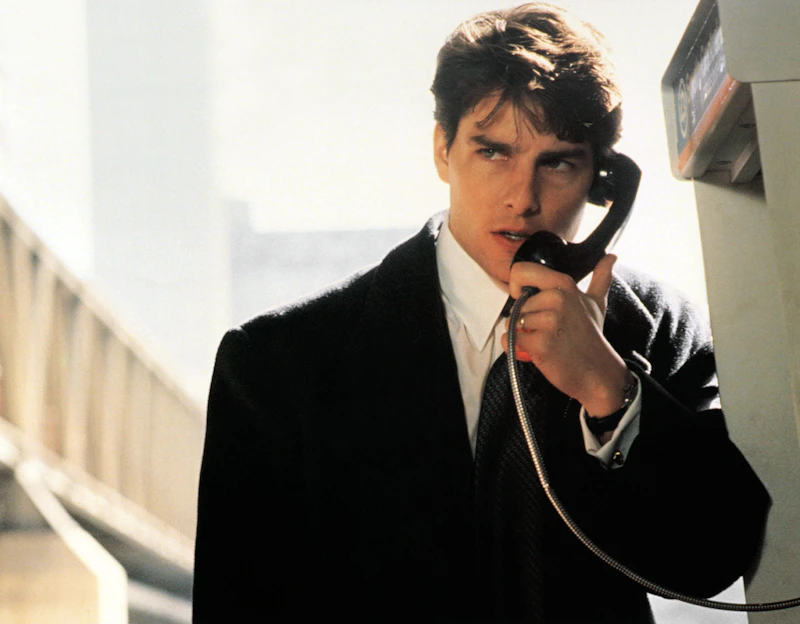
Still, that’s all that Cruise wants in The Firm, working his ass off through Harvard Law while waiting tables and playing his cards close to his chest until he finds the highest, most ridiculous offer someone will give him right out of college. While the titular firm is taking him and his wife on a weekend wine-and-dine down in Memphis, one of the other firm-wives mentions something about how the women aren’t forbidden from getting jobs, if they want. It rubs the wrong way. Everything in town, from the contractors setting up Cruise’s house to the hush-hush nature and contradictory practices of the office start to get his suspicions up, and when it becomes clear that the firm’s a front to represent the Chicago mafia, the FBI are knocking on the door, and any lawyer who’s thought about leaving has wound up dead—his life and yuppie dreams are dead right when they were really getting realized. But he’s Tom Cruise, he can always play both sides and outsmart them. That’s why we watch him, because he’s the best.
Eyes Wide Shut remains his stand-out role, leaving Cruise totally in over his head and lacking an exit strategy. His antics and assertions only getting so far as to discover that he’s onto something he shouldn’t even know about, and his upper-middle class Dr. Bill Harford is no match for the elite he serves house calls for but secretly wishes to join. It takes The Firm director Sydney Pollack to really hammer it in, telling Cruise that the insane, esoteric masked sex party he wandered into is all a pageant, but nonetheless can get him into more trouble than he knows he’s asking for.
Stanley Kubrick, the meticulous and overthought-out director, was very likely directly in conversation with Cruise’s earlier roles through Eyes Wide Shut. The parallels to The Firm are too specific to be ignored; not just the broad strokes of aspirational wealth and upper-class conspiracy, but even small details like the blackmail photos of a brief one-night affair resembling Cruise’s imaginings of his then-wife Nicole Kidman sleeping with the sailor in Eyes Wide Shut.
It’s no mistake that Kubrick’s film about the depths of fantasy would showcase the embodiment of Hollywood fantasy, the hesitant but happy smile that belies an explosive seriousness behind every early Cruise performance, which turned his face into an image of the new dream born in Reaganite austerity and sent to the top of the stock market Clinton’s neoliberal 1990s, before the dream came crashing down again with the towers, and people were forced to either wake up or let psychosis take hold of them (for the vast majority, it was the latter).
Risky Business is too nascent to guess where things are heading beyond an invisible crack forming, and The Firm is a fantasy meant to line VHS shelves. I’m skeptical of the idea of Kubrick as a perfect thinker or even as a puzzle maker, leaving clues for detective viewers to unlock the real truth of the world. I do think that Kubrick was smart enough to identify the bullshit as the center of this new American myth of upward mobility, to see it as another unending ruse put on by those already at the highest echelons of power, and that the desire to aspire to it in the first place comes from a repressed psychosexual energy.
What’s most shocking is that Eyes Wide Shut reveals something of an optimist hiding within Kubrick. It’s not the how-did-he-pull-it-off Hollywood getaway of The Firm, but the opposite: Eyes Wide Shut is a movie precisely about Cruise not getting away with it. The film shows over and over Cruise’s endeavors to be follies, that he’s been searching for something unreachable the whole time just because it seemed like it was always almost within his grasp. That American Dream was just a dream, not something that’s waiting for us when we open our eyes. As Kidman says at the end: “The important thing is we’re awake now, and hopefully for a long time to come.”