
Now Robert Ehrlich Jr. has something new to chew on other than revenge and vindication. He can stare across the borders of two neighboring states and wonder what could be, or dither and consider what might have been. In either case, he’ll now have to make a decision.
The winning results for Republican candidates for governor in Virginia and New Jersey might appear tempting at first glance. But add to the mix two recent Maryland polls—the first showing incumbent Democrat Martin O’Malley beating Republican Ehrlich by 11 points and the more recent survey yanking O’Malley back to a realistic seven points.
If there’s any consolation for Ehrlich in the recent Clarus Research Group survey, it’s that 40 percent of those polled disapprove of O’Malley’s job performance and in neither poll does O’Malley get beyond the red zone and above the magic 50 percent hash mark. O’Malley defeated Ehrlich by six points in 2006, dispatching him after a single term as the first Republican governor in a generation.Yeah, yeah, I know. The poll’s now and the election’s a year away, time enough for the economy to completely drag O’Malley under with that 10.2 percent unemployment rate pulling like an anchor.
Ehrlich has been telling anyone who’ll listen, both in public and in private, that he’ll consider a re-match against O’Malley if two conditions are met: First, if he can raise enough money (he collected $18 million in 2006), and second, if he thinks he can win. Ehrlich’s elaboration doesn’t go very far beyond those conditions except to say that he’ll be conducting polls and focus groups to measure the risk, shorthand for he hasn’t made up his mind.
Virginia and New Jersey are not exactly Maryland. For this we can be thankful. New Jersey has the highest property tax in the nation and Virginia has sprawling rural areas as well as a huge military presence. And Virginia could very well have one of the worst and most tangled highway and road systems on the North American continent.
Voters are in an unforgiving mood. Jon Corzine, Jersey’s ejected Democratic, is one of the most reviled public figures in the state because of his inability to deal with the state’s tax problems and its chronic budget imbalance despite his reputation for financial wizardry. As a former Goldman Sachs executive, he was joined at the hip in voter’s minds to the recent Wall Street meltdown and the nation’s economic crisis. As if to underline his Wall Street cachet, Corzine spent spent $63.2 million of his own money, a very extravagant ego trip. What’s more, New Jersey, although solidly Democratic, has a history of electing Republicans (Christie Whitman, Thomas Kean) despite being the home state of political Boss Frank Hague with a long history of inbred political corruption.
Across the Potomac and closer to home, Virginia is a landscape of contradictions. Fairfax County, one of the nation’s wealthiest, is Virginia’s rendition of Maryland’s Montgomery County. The two are related by commerce. Virginia, the cradle of presidents, is home to Monticello, Mount Vernon, Old Town Alexandria, Williamsburg, Bush Gardens and Kings Dominion. The rest is resort, military and rural.
The Democratic candidate for governor, former State Senator Creigh Deeds, ran what many considered a dismal campaign of irrelevance that failed to ignite the Democratic base, especially in populous Northern Virginia. He pounced on a master’s thesis that the Republican, Robert F. McDonnell, had written as a graduate student criticizing working women and homosexuals. Deeds never let go. McDonnell, meantime, telescoped his message of job creation and the economy and Virginia’s haphazard transportation system. The result was a total rout by McDonnell and a Republican victory by 17 points.
In Both New Jersey and Virginia, the Democratic candidates ran highly negative campaigns—Corzine criticizing Republican Chris Christie’s girth, and Deeds numbing voters’ ears with commercials criticizing McDonnell’s positions on conservative social issues. In neither state did independent voters turn out in the numbers they did for President Barack Obama in 2008. In Virginia, for example, the Obama campaign registered 500,000 first-time voters in 2008, most of them young. Exit polls showed that young voters, ages18-29, failed to turn out in both New Jersey and Virginia. And in both states, the Republicans ran as dead-center candidates instead of extremists on either margin.
The real question is, if Erhlich does plunge in for a re-run in 2010, how will he run? There are really three Bob Ehrlichs. As a member of the House of Delegates, he was a get-along, go-along Republican in a swarm of Democrats who was liked by his colleagues in both parties for his good-natured bonhomie. As a member of Congress, Ehrlich was a Newt Gingrich protégé who signed on to the conservative manifesto “Contract with America.” And as a candidate, and later as governor, he was a pro-business conservative who claimed he governed from the middle and whose only aberration from the conservative line was being pro-choice on abortion. In short, Ehrlich has a Zelig-like paper trail that can be used against him like a tar baby
No question that both Ehrlich and O’Malley are considering how to present themselves to the voters in 2010, in the phrase of the moment, as the “agent of change,” a difficult piece of ju-jitsu since both have extensive records as governors. But O’Malley has the advantage of the incumbency and therefore will be able to present “gesture” programs that please various constituencies but cost little or no money. O’Malley must also deal with a $2 billion revenue shortfall when the General Assembly convenes in January, no doubt by cutting the budget since he’s unlikely to raise taxes in an election year.
But Ehrlich has another chit to consider, and that is his personal connection to Michael Steele, now chairman of the Republican National Committee and Ehrlich’s former understudy as lieutenant governor of Maryland. That line of credit, if it still exists, could mean millions of dollars in money and manpower if Ehrlich decides to run,
Reapportionment is legalized body-snatching. And a critical issue for both parties and candidates is that whoever is elected the next governor will reapportion the state in 2012 based on the census that will be conducted in 2010. The jiggering of the district lines will affect not only the political composition of the General Assembly but it could influence the makeup of the Congressional delegation as well, especially the tenacious Rep. Roscoe Bartlett, the delegation’s lone Republican from Maryland’s Sixth District, a ribbon of real estate that stretches across the entire top of the state.
In the gestalt of politics, there is a built-in advantage for a sizeable turnout for Democrats, although not as large as in a presidential year. All statewide officials and members of Congress, as well as Sen. Barbara Mikulski, and all members of the General Assembly and many local officials will be up for an election with many layers of multipliers. Add all of those little constituencies together and they form one large constituency of Democratic voters.
Bear in mind, too, that elections are won on local issues and not on what happened in New Jersey or Virginia or how many of Obama’s supporters in 2008 failed to show up in 2009. And when voters respond to polling questions, they’re reflecting their own anxieties and not necessarily an objective view of a candidate or an issue.
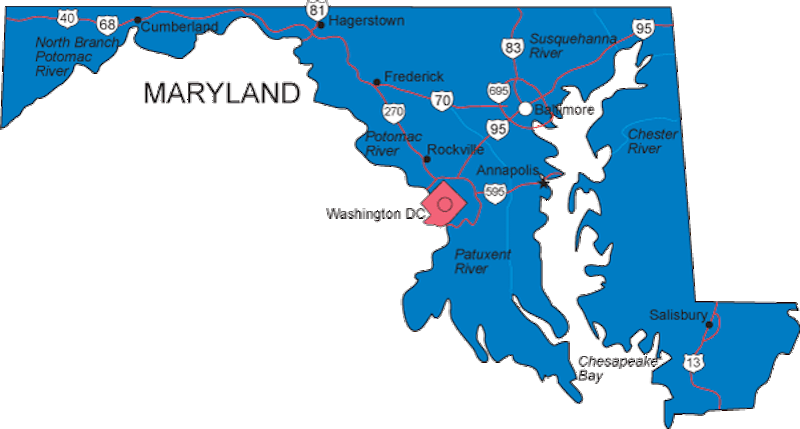
Politics is a form-follows-function kind of business. There are other considerations, too. In the wack-a-do world of political coloration dynamics, Maryland keeps getting a lot bluer just when you think it couldn’t happen. And there aren’t many darker shades of blue left. According to Wikipedia’s color chart, there are 56 shades of blue, the deepest and darkest of which are Prussian blue (it figures) and dark indigo, depending on the preferable tint. And get a load of this: The Hitchhiker’s Guide to the Galaxy lists a hue of blue called “Hooloovoo,” which it classifies as a “super intelligent shade of the color blue.”
So take your pick as to which shade of blue Maryland should be. But as you do, consider these numbers: There are now 1,942,000 registered Democrats in Maryland; 907,734 Republicans; and 479,552 unaffiliated (independents), according to the State Election Board. It doesn’t get much bluer than that.

