

I was stumbling around the East Village a few years ago when I happened on the Pageant Print Shop at #69 E. 4th St. between the Bowery and 2nd Ave. I went in and chatted with the attendant, telling her I ran the website Forgotten New York, and she was familiar with it (this happens wherever I go and I’m always humbled and charmed by this).
I knew the name Pageant. Years ago I was a patron at the Pageant Lounge and Bar, on E. 9th between 3rd and 4th Aves., which was a callback to the former location of Pageant Books. I frequently scoured its stacks for ancient NYC maps and prints. Aisle after aisle of dusty tomes awaited book hawks. It was among the last remaining shops of Booksellers Row, on 4th Ave. between Cooper and Union Squares. Except for the Strand, they’re all gone. The Pageant made a go of it on Houston Street for a while before moving to E. 4th St.
Pageant Books, which now specializes in prints, old magazines and maps, was founded in 1946 by Sidney B. Solomon and Henry “Chip” Chafetz. In its early days the shop published a popular reproduction of the Gutenberg Bible, the first book ever published, in the 15th Century, that employed Johannes Gutenberg‘s new invention, mechanical movable type.
Pageant Books gained popularity because it was frequently employed in location shots in motion pictures including Neil Simon’s Chapter Two and Woody Allen’s Hannah and Her Sisters. Sidney Solomon’s daughters Shirley and Rebecca continued to keep the shop going, in both physical and online business.
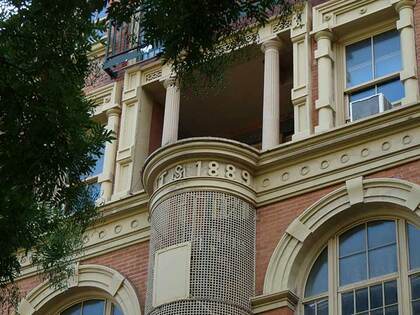
I was aware of #62 E. 4th St., between the Bowery and 2nd Ave., because of its distinctive enclosed exterior spiral staircase and eclectic collection of arches, columns and alcoves. After decades of deterioration, the building’s exterior has been restored to splendor in 2010-2011 by its co-owner with the Rod Rodgers Dance Company, the Duo Multicultural Arts Center, which since 1969 has provided an artists’ venue in the East Village, with an emphasis on Latino culture. The building was constructed in 1889 and has served as meeting hall for NYC’s first Musicians’ Union (established by John Philip Sousa), as well as ILGWU (International Ladies’ Garment Workers’ Union) and as a restaurant and ballroom.
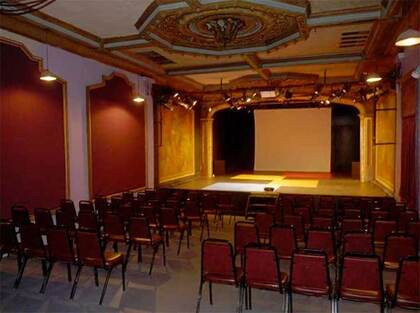
In the late-1960s Andy Warhol used the space, by then known as the Fortune Theatre, to show adult films. The late Jim Carroll was the ticket taker. In the 1970s, Warhol also used the theater as a performance space, and it got the notice of filmmaker Francis Ford Coppola; a scene in The Godfather: Part II was filmed there. The DMAC has been here since 1981, and 62 E. 4th is currently home to performances and art installations, as well as the Rod Rodgers Company dance performances.
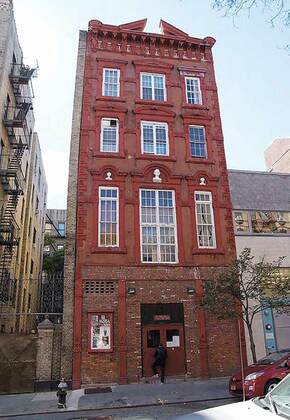
There’s a grand old brick building at 74 E. 4th St. in the East Village, midblock between 2nd and 3rd Aves. Since 1967 home to La Mama Experimental Theatre, the building went up in 1873, designed by architect August H. Blankenstein for the German professional orchestral musicians’ social and benevolent association, Aschenbrödel Verein, and was originally known as Aschenbrödel Hall (the name comes from the organization’s first president, August Asche; “Aschenbrödel” is also a ballet by Johann Strauss based on the “Cinderella” fairytale). The East Village was known as Kleindeutschland, or Little Germany, in the late-1800s and into the 20th century, because of its many German immigrants. The General Slocum steamboat tragedy, June 15, 1904, cost Little Germany the lives of over 1000 residents as they were en route to one of the many recreational spots on the north shore of Long Island. After that, many of the East Village’s German residents dispersed to places such as Yorktown on the Upper East Side. Traces of Little Germany can still be found in the area, and this building is one such relic.
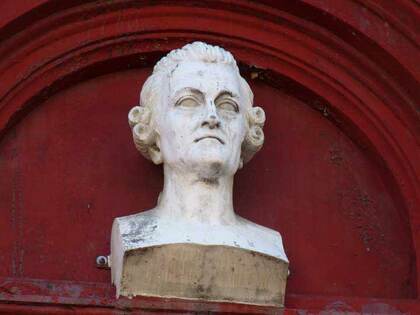
What’s always fascinated me about the place is the three fellows whose busts appear above the lengthy casement windows on the second floor. Most prominent, in the center, is a bewigged representation of Mozart (1756 –1791), flanked by Mendelssohn, (1809 –1847) and Beethoven (1770 –1827). Nearby is the Ottendorfer Library-German Dispensary on 2nd Ave. between E. 8th and 9th Sts., one of the country’s first lending libraries, and a physician’s office depicting busts both mythical and historical figures in the field of medicine.
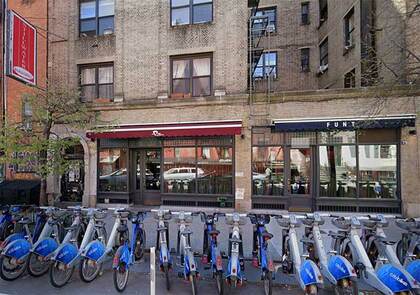
Ella Funt, a French neo-bistro and cocktail bar at #82 E. 4th, occupies the former space of Club 82, described by Jim Naureckas in NY Songlines as “mobbed-up drag bar that was an important venue for the first wave of punk/new wave; the New York Dolls, Television, Debbie Harry (pre-Blondie) all played here, to audiences that included David Bowie and Lou Reed.” It closed by 1978, but had opened as the Rainbow Inn as far back as 1930.
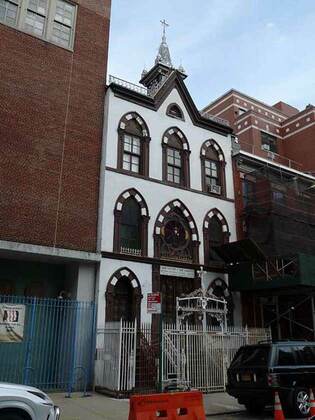
One of my favorite church buildings in the city, not least for its unusual brown and white paint scheme, is the San Isidoro y San Leandro Orthodox Catholic Church of the Hispanic Rite, located at #345 E. 4th. The building was constructed in 1895 as the Roman Catholic St. Elizabeth of Hungary Church, and then became a Russian and a Greek Orthodox church. St. Isidro and St. Leandro were brothers, bishops of Seville in the late 6th-early 7th century and helped convert the Germanic rulers who were the big boys in Europe in the centuries after the end of the Roman Empire.
—Kevin Walsh is the webmaster of the award-winning website Forgotten NY, and the author of the books Forgotten New York (HarperCollins, 2006) and also, with the Greater Astoria Historical Society, Forgotten Queens (Arcadia, 2013)