
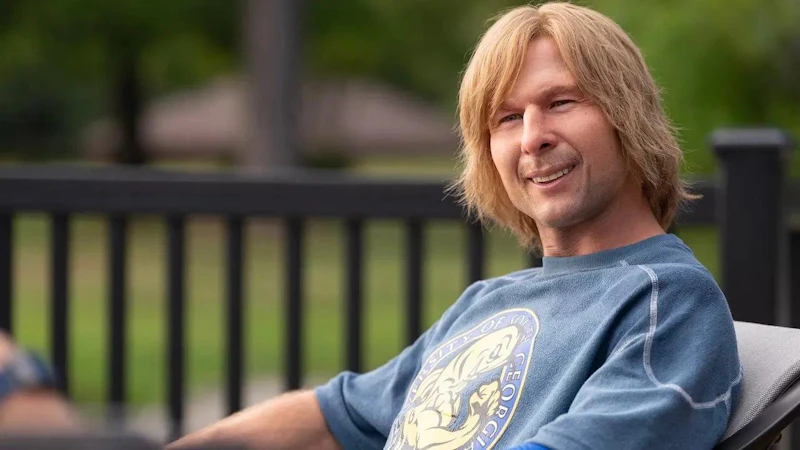
There was a trap many aspiring male actors fell into during the 2010s when Hollywood announced them as A-listers without audience approval, leading to embarrassing flameouts. The most notable of these was Friday Night Lights fan-favorite Taylor Kitsch, who had his dreams of being the next Brad Pitt crushed with the double-blow of John Carter and Battleship, two box-office bombs, in a three-month span. He wasn’t an anomaly, given that the same fate felled Tron: Legacy’s Garret Hedlund, Independence Day: Resurgence’s Liam Hemsworth, Twilight’s Taylor Lautner, and “nepo babies” Jaden Smith and Scott Eastwood. Glen Powell could’ve been another casualty had he not made the conscious decision to fill a void for self-effacing goofballs who don’t demand to be taken seriously.
Powell was smart enough to align himself with Richard Linklater on Fast Food Nation, Everybody Wants Some, Apollo 10 ½, and Hit Man, the last of which he co-wrote. The conceit of Hit Man is that Powell is a mild-mannered professor who’s hired by law enforcement to disguise himself as a fake “hit man” to lure potential criminals, and it required him to play a number of covers that were unique characters. It’s something that Powell took an interest in, since he played similar roles in the Stephen King adaptation The Running Man and the A24 dark comedy How To Make A Killing. It could’ve been seen as a lateral move for a guy who co-starred in blockbusters like Top Gun: Maverick and Twisters, but Powell’s smart enough to know that those films were sold on name recognition, and not any individual member of the cast.
Powell’s avoided “strategic” moves that so many of his contemporaries have tried to make in favor of doing what he’s personally interested in, which may explain the existence of Chad Powers. The Hulu comedy show was inspired by a skit that aired on ESPN’s Eli’s Places, which focused on a former football star who disguised himself as a different player so that he could join a college team. The original sketch was created by Eli Manning, who’s a co-producer on the show with Powell, who has the lead role of the narcissistic collegiate quarterback Russ Holliday. It was after an embarrassing loss caused by his showboating that Russ’ career prematurely ended, and forced him to spend the next eight years as an underachiever. It was after the discovery that his father, makeup artist Mike Holliday (Toby Huss), has advanced prosthetics capabilities that Russ decided to don a facade and try out for the South Georgia Catfish football team as the dorky recruit known as “Chad Powers.”
The first season of Chad Powers was done in the style of a 1990s sports comedy, for better or worse. There’s gross-out gags, slapstick sequences, and exaggerated caricatures of specific sports figures. Powell had given himself a venue to wear fake teeth and do a silly voice, but the surprise of Season 2 is its understanding of the limited appeal of that schtick.
The high-energy, frequently nasty depiction of the NFL might strike some as unnecessarily cartoonish, but the bitterness that Chad Powers has about the fleeting nature of fame is preferable to the idealistic optimism of Ted Lasso. Powell and co-showrunner Michael Waldron understand that ambition can lead people down dark paths, and that public reaction can turn immediately after one high-profile success or failure. The second season has Russ forced to come up with excuses to explain his bruised makeup in the middle of games, with knowledge of his true identity only known by the team mascot Danny (Frankie A. Rodriguez) and assistant coach Ricky Hudson (Perry Mattfeld), whose father Jake (Steve Zahn) is the head coach of the South Georgia Catfish.
The maze of lies between them makes for a comedy of errors; Ricky’s infuriated by Russ’ lie, but has used it as a tool to impress her father. The more dramatic component is that Jake has suffered from heart problems that he’s hidden from his daughter out of fear that it would affect her decisions as a coach, given that she’s bound to face more challenges as a woman in the NFL. That Jake’s able to be more honest with Chad is an irony because he doesn’t know that he’s been talking to Russ, a character who’s suffered an identity crisis of his own. The dilemma that Powell is the best at showing is the falseness of victory; Chad was created as a tool for him to have a second chance, but it also caused people to fall in love with someone who’s completely different than Russ.
Being released all at once, as opposed to the weekly rollout of the first season, was the better option for Chad Powers because it’s structured like a football game. There might be time for brief timeouts and breaks, but no one wants to spend weeks waiting for the outcome of a single game. The gameplay itself is also improved in the second season, with a first episode that has a more captivating depiction of American football than any film since 2004’s Friday Night Lights. Chad Powers is still a half-hour comedy, but it's now clear why Powell got so many talented actors to be part of the ensemble. I was confused at first why a versatile character actor like Zahn would sign on for such a nothing role, but Season 2 gave him the chance to deliver fiery tirades and a few sincerely emotional fatherly speeches.
What’s notable about Powell is that he’s now spent more time as Chad Powers than any other character. Commitments can be draining for young actors who don’t want to spend years on a contract, and Powell has avoided signing a multi-picture deal for Marvel, DC, or Jurassic World; the only upcoming sequel he might be in is a potential third Top Gun, since Twisters didn’t perform well enough to get a follow-up. In all likelihood, Chad Powers exists because of the dearth of comedy roles Powell has been offered in films, so he created a platform for himself.