
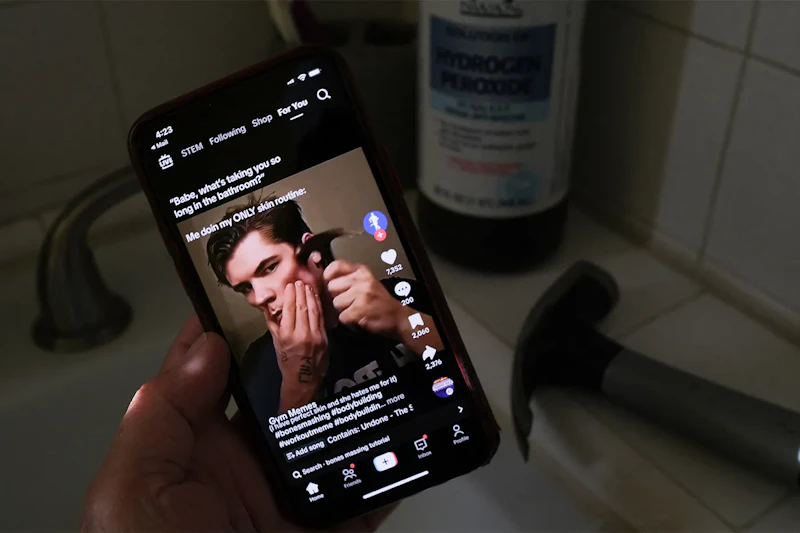
Looksmaxxing sounds like a bad joke. Young men cataloguing their canthal tilt, debating bone structure on forums with the argumentative density of legal scholars, tracking facial harmony scores the way their fathers tracked batting averages. Mewing routines. Jaw exercises. Light angles studied like cinematographers preparing a shot. Spreadsheets.
Laugh if you like. But before rolling your eyes, consider what looksmaxxing actually represents: the third and most revealing chapter of a movement that spent two decades trying to figure out what men want. The answer, it turns out, isn’t what anyone predicted.
Context, unfortunately, is required. The first phase belonged to the pick-up artists. The Game arrived in the early-2000s, and with it came men peacocking in nightclubs, wearing eyeliner and spouting carefully curated phrases. Males in their 20s and 30s attended weekend seminars in airport hotels, filed "field reports" online, and treated attraction as a lock that could be picked with the right sequence of moves. Women were targets. The scoreboard was clear. For all its manipulation and underlying sadness, at least the goal made sense. Men wanted women. Women, mostly, wanted men. There were techniques.
The second phase turned darker and considerably more profitable. The red pill arrived with a ready ideology, a built-in enemy, and Andrew Tate. Incel forums spiraled from loneliness into structured grievance—terminology, martyrs, theology. MGTOW—Men Going Their Own Way—dressed romantic withdrawal in philosophical clothing and called it liberation. The frame flipped. Women were no longer targets but enemies of sorts, gatekeepers of a sexual market nobody had asked them to navigate. Congressional hearings followed. Think-pieces multiplied. Platforms built trust-and-safety teams. The cultural response was serious and, in its way, warranted.
The diagnosis, though, was frequently sloppy. "Toxic masculinity" became the catchall—a phrase that explains everything and nothing. The conversation went macro when it should’ve gone granular. Every man became a suspect. Every expression of masculinity became evidence. The imprecision drove the men most in need of serious engagement straight into the arms of the rage merchants who, whatever else you might say about them, were at least paying attention. The problem was named badly. Nobody should be surprised it got worse.
Phase three—the looksmaxxing era—looks at first glance like conceit taken to a clinical extreme. The standard interpretation is that it remains, underneath the bone-structure discourse, about women. Better jaw, better dates. Improved aesthetics, improved position in the mating market. Spend time in these communities, though, and a different picture emerges. Women are nearly absent from the conversation. The metrics are adjudicated entirely within male spaces. The validation sought is male validation. Every commenter’s male, every competitor’s male, every judge is male. The new axis of competition runs not between men and women, but between men and men, with women somewhere off in the distance, surplus to requirements.
The manosphere, in its current form, has little interest in mating or dating. The resentment that defined phase two has turned inward so completely that outward antagonism barely registers. Women haven't been pushed out. They’ve simply faded. The conversation consuming young men now concerns lighting angles and midface ratios, not female psychology or Tinder benders.
The irony writes itself. Second-wave feminism built separatist communities around reclaiming the female body and declaring men largely irrelevant. The looksmaxxing world has built separatist communities around reclaiming the male body and declaring women largely irrelevant. The politics couldn’t be more opposed. The psychology, however, is almost identical. And the participants—contrary to the chest-thumping, red-blooded masculine image the manosphere once projected—have more in common with socially awkward tech nerds than with the smooth-talking studs they claim to admire.