
I can’t read or write Russian. Or Italian, French, Gaelic or Chinese. As a mediocre Spanish student in high school and college, I can get by on a rudimentary level. One language I tried—five times—is that used by National Review senior writer Michael Brendan Dougherty, whose October 19th “Guest Essay” in The New York Times, “The Midterms Look Dark for Republicans. Their Future Looks Brighter,” was incomprehensible. Dougherty, 51, is a successful journalist and author, so it could be that the Times, always searching, especially when an election’s coming up, for “deeply researched” and what they consider erudite “think pieces”, imposed a fast deadline for the moderate conservative. Alternatively, the Times today pays almost nothing to guest contributors (pretty chintzy for a cash-machine company), so Dougherty just whistled—but didn’t work—his way through a diagnosis of the Republican Party’s future.
He cites polls (foolish) and employes cliches: “Two things can be true at once. Mr. Trump is the party’s great unifier, and going into 2026, he’s the party’s biggest drag.” Insight! A political revelation! Trump isn’t as popular as he was in 2024, but hasn’t lost his “playing chess” sense of humor. (It’s largely forgotten now, but two years ago his photo-op as a McDonald’s cashier wasn’t only savvy, but authentic, and likely swung some undecided voters.) His latest riff is publicly admiring the physical attributes of other men, such as incumbent Ohio Sen. Jon Husted, who according to the President has an awesome ass and hands. That’s funny, and probably confounding to Democrats who don’t get what he’s up to. (I wish the meme of Trump talking to the kid mowing the White House lawn would get revived; could be I just haven’t seen that one lately.)
Dougherty: “By smashing the former consensus in the party, [Trump] has allowed new elected figures and influencers to start building a different G.O.P… There is a model for what this kind of Republican Party can become. The New Deal Democrats were the most dominant political coalition of the 20th century. That party joined urban Catholics with Southern segregationists, farmers with union workers and, increasingly, Black Americans as well… The long multifarious life of New Deal Democrats shows that a looser coalitional arrangement can dominate electorally, and even manage enormous internal cultural differences and contrasting priorities for decades.”
It’s a Dougherty fantasy, or “thought experiment” but I’m not buying it. He’s correct that the New Deal voting bloc was the most dominant of the 20th century—from FDR’s election in 1932 to Eisenhower’s victory over Adlai Stevenson in 1952—but it was born of the Great Depression and then World War II, a confluence of events that isn’t in evidence today, despite what Democratic pundits/lackeys say about the loss of democracy, Trump’s corruption (out in the open, unlike Biden, Obama and Bill Clinton and members of Congress from both parties) and the rise-and-fall, and more rise-and-fall prices at gas stations, supermarkets and the financial markets.
At least Dougherty has a roster of his future GOP (unlike Democrats, who’ve yet to even tentatively rally around a 2028 presidential candidate). He fills his “big tent” with people like Brian Kemp, “the manosphere,” J.D. Vance, Marco Rubio, Jillian Michaels (friend of “MAHA moms and the wellness right”), Josh Hawley, Bobby Jr., John Fetterman, Rand Paul, Ted Cruz, Steve Bannon and Ron DeSantis. Dougherty isn’t without humor, if slight: “A coalition loose enough to let Mr. Fetterman in the front door is also loose enough to let [Tucker] Carlson escape.”
His conclusion: “The traditional stalwarts for small government are still in there, and still have influence. But the party is no longer in their grip. They may find the party lasts longer and goes a little harder under conditions of anarchy.”
Given the parched patch that defines the Times’ opinion/editorial pages, Dougherty’s tango, although very confusing, is okay, even if a Berlitz class is advisable. But it would’ve made more sense once the midterm results are in.
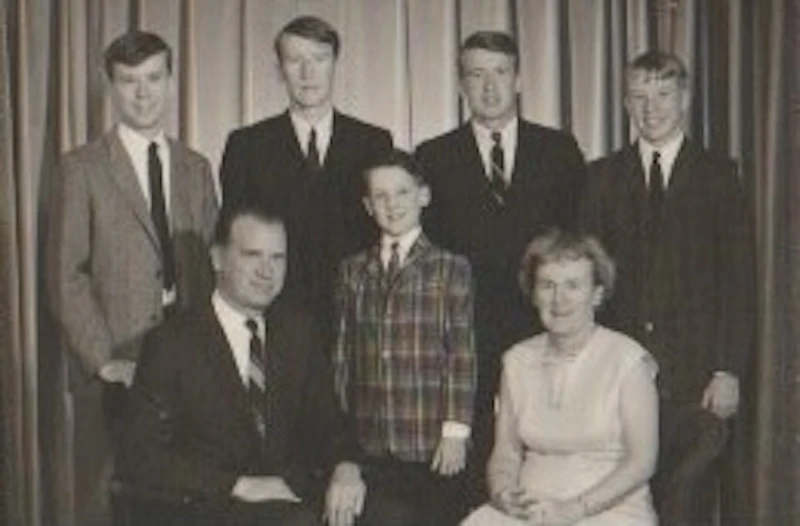
The accompanying photo of my family (I’m the squirt in the madras sports jacket) was taken one November day when the “New Deal Coalition” was starting to crack. I’d guess such portraits were commonplace back then; on a special occasion go to a local pro and two weeks later have a Christmas card decoration. After this picture was taken—torture for the boys—the recompense was a fried-clams dinner at the local Howard Johnson’s.
Take a look at the clues to figure out the year: teenager Martin Amis is in the film A High Wind in Jamaica; the last work of J.D. Salinger (before his death) is published in The New Yorker; Margaret Drabble’s The Millstone, Norman Mailer’s An American Dream, Arthur Hailey’s Hotel and Ralph Nader’s Unsafe at Any Speed are published; Sam Mendez is born and Randall Jarrell dies; Ford Frick’s awful 14-year tenure as MLB Commissioner ends; the great Maury Wills leads MLB in stolen bases (94); the Orioles’ Curt Blefary is the American League’s Rookie of the Year; Ronnie and Reggie Kray are arrested, and then acquitted, in London; Darling, starring Julie Christie, is released in London; Nina Simone’s Pastel Blue is released; Lionel Bart is ruined after his play Twang!! flops on the West End; the Supremes “Back In My Arms Again” is the group’s fifth consecutive #1 single; and Thunderball is released.
—Follow Russ Smith on Twitter: @MUGGER2023