
The first time I “saw” Grouper live, I couldn’t see her. It was the second night of Animal Collective’s spring 2009 tour at the 9:30 Club, and the place was teeming with lacrosse bros high on the hype of that year’s Merriweather Post Pavilion. Grouper (Liz Harris) was one of many innovative openers that Animal Collective boosted, along with Tickley Feather, Black Dice, Gang Gang Dance, Dan Higgs, and Vampire Weekend; her 2008 debut for Kranky Records, Dragging a Dead Deer Up a Hill, received some positive notices upon its release, but it was really that spring 2009 tour that lodged Grouper’s music into the American indie consciousness, where she’s remained for nearly two decades. Unlike so many of the bands and artists of her peerage, Harris, 46, has grown in popularity and influence and, admirably, protected the integrity of her work from busybody middlemen and the bloated corporate “indie” imprints that sandbag so many promising musicians.
Since 2011, Harris has operated her own record label, Yellow Electric, and independently released a number of records, including her masterpiece AIA: Dream Loss / Alien Observer, a double album split into two releases a la Use Your Illusion or Nelly’s Sweat Suit. She’s continued to put out records sporadically on Kranky, including 2018’s Grid of Points and 2021’s Shade, but she’s been considerably less prolific in the last 15 years: every album since 2014’s Ruins has been old material, either delayed or shelved. Never operating in either the music world or the art world fully, Harris has managed to avoid the vicissitudes of trends and corporate turnover entirely on her own terms. She releases so little music that every release feels like an event, to the point that her 2016 7” single Paradise Valley (“Headache” b/w “I’m Clean Now”) is considered one of her red-letter records. The songs are beautiful, and it’s hard to think of another contemporary artist with such command over their audience.
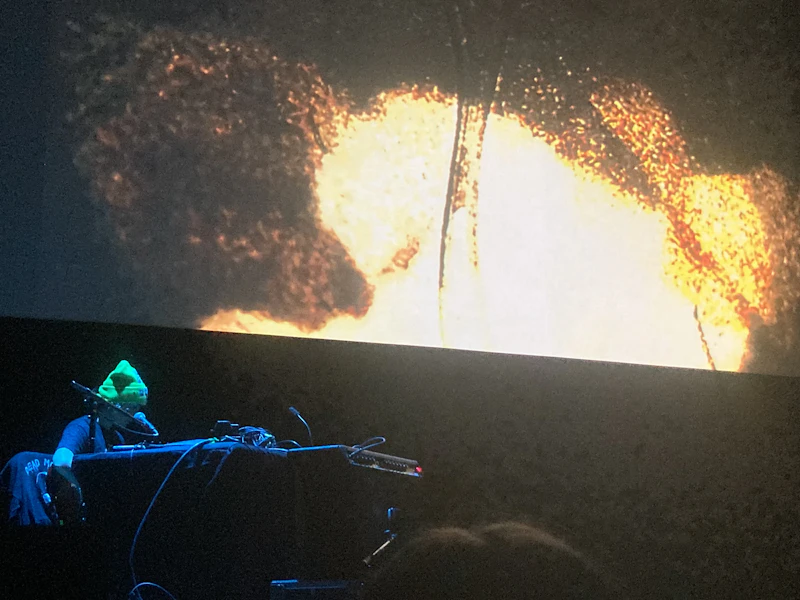
Grouper plays very quietly. You wouldn’t necessarily think that listening to the records, full of distortion and dislocating reverb, but when you see her play, you sort of have to strain to hear her. Since that 2009 show, I’ve seen her three more times: 2015 in Richmond, 2018 in Philadelphia, and this past Saturday in Washington, DC. The show at the Lincoln Theatre was general admission, and we ended up in the second row, right in front of the speakers. Opener January Hunt made the most of the subs and finished her largely instrumental set with a brief bit of conversation, albeit left unresolved. Grouper went on about half an hour later, backed by Brakhage-esque video art.
Despite making a point to never acknowledge the crowd, Harris “played the hits”: “Invisible,” “Headache,” “I’m Clean Now,” “Poison Tree,” “Holofernes,” and “Alien Observer,” all of which have been sampled by other artists and/or used in movies and television shows. She’s never mounted a full U.S. tour, she almost never gives interviews, and, unlike 90 percent of public figures today, she has the kind of mystique and aura that someone like Prince or David Bowie had in their prime. The “democratization of music” robbed artists of their mystique, forever humbled with hat in hand, and Grouper has managed to avoid that despite maintaining an active Instagram account (captioned “Corporate storage”). She’s playing the long game, never burning herself or her audience out with constant updates, releases, and shows. There are very few non-nostalgia acts who could sell out a venue like Town Hall in Manhattan two nights in a row playing material that was written and recorded over a decade ago. Her shows beg the question: does it matter? Is a song from 2008 like “Poison Tree” somehow not “fresh” anymore? Of course not. By removing herself from the cultural-critical apparatus that traps artists in narratives and timespans, Harris has allowed her music to live in an eternal present, forever fresh and relevant.
The dynamics of her performances can’t be understated. She plays very quietly, but always at the end, the noise rises to a crescendo before suddenly cutting out, along with the houselights—by the time the lights come back up, Harris is gone. Talk about aura! It sounds ridiculous, but I’d be disappointed if she ended her set with a polite “thank you for coming” and a smile and a wave. On Saturday, she closed with “I Saw a Ray,” filling the theater with fuzz and static and sending us through a sonic thresher. Sounds of lightning, water, and wind followed, and after a brief spoken word segment (entirely indecipherable), Harris watched her tape player revolve to its end, and stood up with the houselights still on. She waved to the crowd, her head parallel to the floor, stone-faced and still coming out of her own dream. She mimed another wave, gave us the devil horns, and walked off without a word.
Grouper’s not a Millennial nostalgia act like Animal Collective has become. Looking around, most of the audience in DC were under 30, with a healthy smattering of fans who might’ve just discovered her a couple blocks away at the 9:30 Club in 2009. But the haze, the doom, the darkness of her music is clearly resonating more with Zoomers than it ever did with my generation. Thank God! When so many musicians have let you down, someone like Grouper remains a steadying, inspiring force.
—Follow Nicky Otis Smith on Twitter: @NARCFILM