
Robert Siodmak’s 1946 The Killers is three films in one. The first is a brief but effectively brutal adaptation of the Hemingway short story about a contract killing in a small town. The second’s a cold-hearted noir in which a cold-hearted dame casually castrates some dumb lug and then makes off with the dough as he bleeds out. And then the third’s a tedious detective story in which an upright insurance salesman plods his way righteously towards the restoration of law, order, and the bottom line.
Unfortunately, it’s the last film within a film that takes up the bulk of the screentime. There’s a great movie fighting to get out here. But like the star dumb lug, it’s KO’ed early and never recovers.
The Hemingway adaptation, complete with terse, sharp dialog and pervading existential despair, is put at the beginning. Two ominous hitmen (William Conrad and Charles McGraw) show up in the sleepy town of Brentwood looking for the Swede (Burt Lancaster, in his debut role). They rough up some locals in a diner. But when those locals escape and try to warn the intended victim, The Swede refuses to flee. He just lies on his bed, flaccid and deflated, and declares, in funereal tones, that there’s nothing to be done.
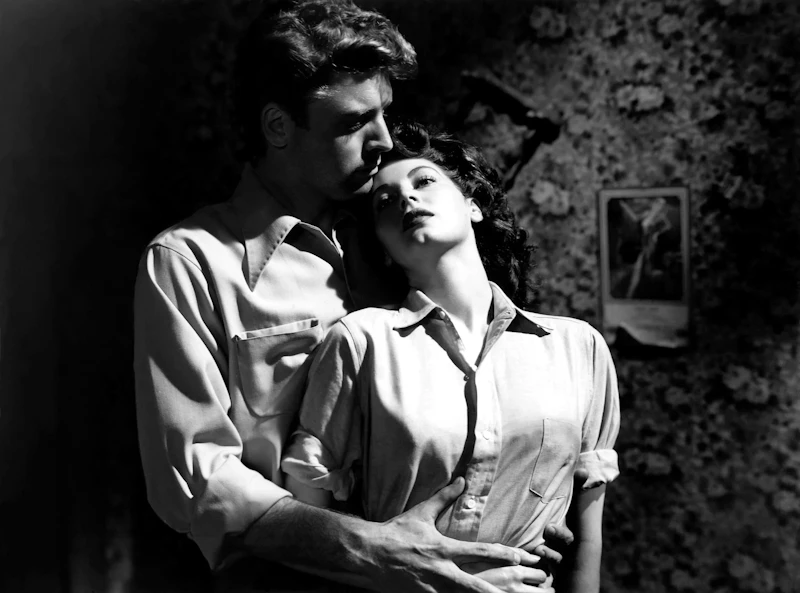
What has sapped the Swede’s manly will to live? It’s a woman—and that’s where the noir comes in. The Swede, or Ole Anderson, was a boxer until he busted his good right hand. Symbolically castrated, he stumbles haplessly into the orbit of the brunette Kitty Collins, played with feral sensuousness by Ava Gardner. Kitty doesn’t do much besides shoot Ole a glance or two and flex her fully-clothed curves off to the side on a conveniently placed bed. But that’s more than enough to light the screen on fire, and poor Ole too.
Gardner and Lancaster are a perfect noir pairing; he radiates confused trusting innocence and pure lust-inspired love; she radiates the opposite. Unfortunately, you barely get to see their twisted dynamic play out. That’s because almost the entire movie is devoted to the adventures of noble insurance investigator Jim Riordan, played by Edmond O’Brien, who’s very much not Ava Gardner, and not Burt Lancaster either.
If you have Gardner and Lancaster on the payroll, deciding to point the camera at Edmond O’Brien for any length of time shows a shocking lack of judgment. Even so, the failure of the film isn’t really O’Brien’s fault, saddled as he is with a script that manages to be needlessly intricate and relentlessly dull. Riordan strides hither and yon, interviewing a range of equally uninteresting stereotypes (the good Catholic maid; the good blonde, the good policeman, the hardened gunman, etc.) in pursuit of the Truth, and of the proceeds of the robbery at the heart of it all.
The details about the robbery aren’t really important. Instead, what’s important is masculine anxiety. Ole’s failure as a boxer makes him a failure as a man, ripe to be seduced and tossed aside by the femme fatale, who destroys him partially for greed, and partially because she knows she can. When Kitty threatens to murder her sugar-daddy, bigtime thug Big Jim Colfax (Albert Dekker) in his sleep, the film suddenly comes alive with vindictive, gleeful status threat. It’s the mirror image of Ole lying in his bed waiting for the killers to come; she has taken all his manly gumption and turned it into vicious sexual and murderous heat.
But director Siodmak is unwilling to let that heat burn the viewers, as it does in classic film noirs like Double Indemnity or even Laura. In the latter, gender anxiety and perversion infect even the detective investigator, who presents himself as an objective restorer of patriarchy, but who soon falls in necrophiliac love with the dead girl, compromising himself and the social order. In contrast, Riordan’s never tempted. Kitty attempts to insinuate herself into his hotel room right at the end, but he’s far too manly and level-headed to be duped by her charms, and is in any case chaperoned, unbeknownst to her, by the police.
It's not uncommon for noirs of the period to end with the patriarchal verities restored; the femme fatales rarely win the day until the era of neo-noirs like Body Heat (1981) and The Last Seduction (1994). But even in the classic era, the point of most noirs is to raise the terrifying, furtively masochistic specter of a world in which women refuse to stay in their assigned roles and men slide into disgusting debasement as a result.
The Killers gives you flashes of woman as poisonous manipulator and glimpses of man as paralyzed invalid. But then it returns to happy, virile, incorruptible Riordan marching towards hearty, healthy heartiness. Gardner and Lancaster and that opening scene remain indelible. But it’s hard to enthusiastically recommend a film that so smugly blots out its own best—or if you prefer, worst—impulses.