
It was earlier this month that One Night Only used a hackneyed totalitarian future premise to explain why two young people would be desperate to hook up, and earlier this year the Netflix hit People We Meet On Vacation found creative means to justify shooting in expensive locations. This year’s highest grossing romance is The Drama, a dark comedy centered on a school shooting joke that invited its own exhausting discourse. The fear of being deemed “generic” has pushed filmmakers to write themselves into corners, and they forget that “formulas” exist for a reason.
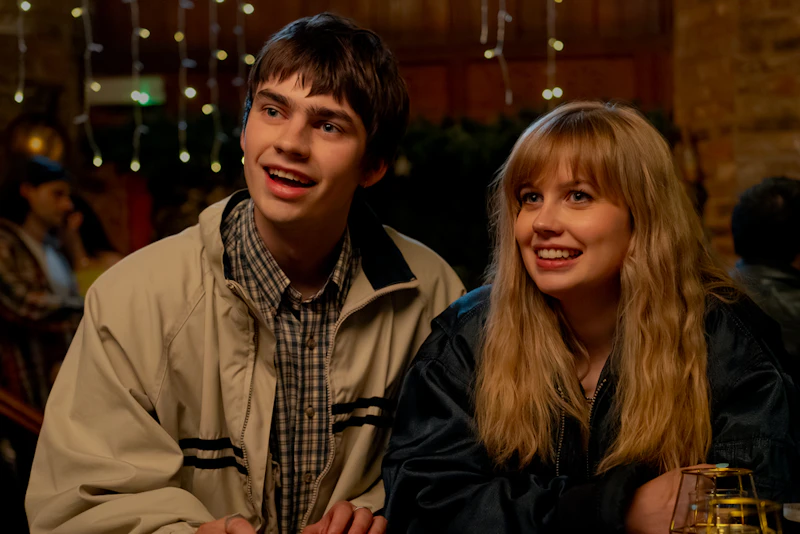
Finding Emily doesn’t spend its entire runtime apologizing for being a rom-com. The clash between convoluted plot mechanics and untenable sincerity, often a source of tension in rom-coms, is represented in Finding Emily by its two main characters. Owen Brompton (Spike Fearn) is a sound engineer at a student union bar at a university in Manchester City, and he’s bought into the notion that a momentary connection is a sign of true love; Emily Raine (Angourie Rice) is a student at the same university, and has started a thesis with the proclamation that love causes irrational self-destruction. Their “meet cute” is explained in a shrewd way, and the reason they stick together makes sense. Since this is 2026, there has to be a deeper reason that these characters would meet up with one another in real life because it’s more awkward for them to act casually.
Owen fell in love with a girl (Sadie Soverall) at the bar who he’s determined to reconnect with, despite only knowing that her name is “Emily.” It’s in a desperate attempt to find a girl named Emily on a huge campus that Owen’s accidentally introduced to Rice’s Emily, who has the realization that he’d be a perfect subject for her thesis. The broad archetypes of a “romantic” and a “cynic” might be what define these characters at first, but there’s depth to the script by Rachel Hirons. Owen has feared of being on his own after his brother said he’s getting married, and Emily has pursued an academic explanation for emotions because of a messy situation with her roommate. Neither of these dilemmas are life-changing, but they might feel that way for a 21-year-old college student and a 23-year-old campus employee who haven’t experienced much outside of their insular academic experience.
The escalation that the film’s predicated on is Owen’s attempt to reach out to any girl on campus named Emily through a database of students, which is provided to him by Emily Raine. It’s a hasty decision that’s befitting of a character who’s so obsessed with a one-night encounter that he can’t see the girl in front of him, but it’s a far less egregious leap than many other rom-coms with (supposedly) more mature characters. The reaction spurred upon by Owen’s misguided groupchat-starter (the result of accidentally cc’ing everyone) on campus is one of confusion, amusement, skepticism, appreciation, and outrage by the student body, and it’s the most modern storyline in the film. Owen’s subjected to the scrutiny of a social media-pilled generation, filled with those who’d doubt his intentions. Even if he’s become someone for others to project their personal grievances upon, this is the realistic fallout of any overanalyzed act of sincerity.
The double-edged sword of intentionality is well-approached in Finding Emily because both characters are equally superficial, yet sympathetic in their own ways. In Owen’s eyes, there’s no logical reason for Emily to help him find another girl who shares her name, so he’s taken her compassion as entirely selfless; Emily does feel guilty because she hasn’t disclosed to Owen that he’s part of her study, but she’s nonetheless fascinated by his dedication. These are ploys, of course, because Owen’s search for the “real Emily” and Emily’s thesis preparation are the tools needed to ensure that they stick together. Yet, Finding Emily is able to avoid the more obvious cliches. It would’ve been easy for Emily to be a cold, detached pessimist who has to have her mind changed, but Rice has a bubbly personality and infectious energy that’s representative of an eager-minded degree-seeker. Similarly, Owen isn’t a lonely incel, and can be charming because he isn’t wearing a facade.
There are simplifications needed to make Finding Emily flow, with an unnamed campus that’s like a high school where everyone is on a first-name basis and student organizations have a real sway. There’s an over-the-top feminist student body president in Emily Thewlis (Kat Ronney) who’s positioned as a secondary antagonist because of her assertion that Owen’s a predator; some might take this as an attack on third-wave progressivism, but it’s no more ridiculous than some of the immature male characters who make crude remarks about the situation. The minor handicaps are easily forgiven because of the confident direction by Alicia MacDonald, who has an understanding that rom-coms require the same technical flourishes as any other film. Finding Emily has crowd shots with diverse reactions, set pieces with strong blocking, and a soundtrack filled with early-21st century pop songs just old enough to be nostalgic.
Finding Emily isn’t burdened by familiar story beats because of the chemistry between its two young stars. I’ve waited for Rice to get a chance like this for a decade since her standout role in The Nice Guys, where she played Ryan Gosling’s daughter. As for Fearn, it’s a chance for him to prove that the weakness in past credits like Back to Black and Ella McCay were due to the scripts, and not his performances.