
The Daily is here to help. That’s why we ran a
special housing issue last week, filled with valuable advice about
leases, landlords, and life as a tenant. Read it, and you’ll be ready
to find a little place of your own.
However, we did neglect to mention some of the other challenges a
tenant faces. You only sign a lease once a year, and you only pay rent
once a month. But there are other skills apartment-dwellers use on a
regular basis, like scheduling showers so you can actually get some hot
water. Or tactfully informing your neighbour that her sex life keeps
you awake at night. Or writing passive-aggressive notes to your
roommates.
That last one is an essential skill. Sometimes your roommates will
annoy you, and passive-aggressive notes are a great way to get your
point across without a direct confrontation. Unfortunately, McGill
doesn’t cover passive-aggressive notes in its creative writing classes,
and Microsoft Word doesn’t have a template for them, so The Daily is
here to help you out. Here’s a five-step formula you can follow – just
like the one for business letters – that’s guaranteed to produce
results.
Step One: Pretend you’re writing to complete strangers. This may
seem odd, especially if you only have one roommate, but a passive
salutation is essential. Don’t use “To whom it may concern,” though.
Your salutation is also an opportunity to snidely introduce your issue,
so “To the person who keeps leaving the refrigerator open,” or “Dear
regular users of the bathroom” are much better choices.
Step Two: Overstate the obvious. Begin the body of your letter with
a statement nobody would disagree with, like “Refrigerators are
designed to keep food cold,” or “It is customary to flush the toilet
after using it.” (“Dishes do not clean themselves” is another popular
choice.) Statements like these are hard to refute, and they also imply
that the root of the problem is your roommate’s ignorance, which paves
the way for…
Step Three: Patronize your reader. Now that you’ve established what
the problem is, propose a solution: “Closing the fridge door after use
will keep food cold, thus ensuring that a week’s worth of groceries do
not go bad.” Don’t forget to be condescending: explain your solution in
painstaking detail, as though you’re writing to visitors from another
planet. Including an instructional diagram is a nice touch, especially
for simple tasks like operating a toilet handle.
Step Four: Make veiled threats. This step is optional, but a little
coercion can go a long way. Striking the right balance between passive
and aggressive is essential here, so avoid direct threats. Instead,
refer to potential consequences as if they’re forces of nature: “If the
fridge door continues to be left open, the PlayStation may disappear
from our living room.”
Step Five: Be excessively polite. It’s tempting to sign off
angrily, but remaining calm and sarcastic is a better choice. However
insincere it may be, “Wishing you many happy hours of toilet use” is a
safeguard in case your roommate gets angry. It’s like using “With all
due respect” or “No offence” to preface insults; at least you can
pretend that you were being civil.
Congratulations! You’re now ready to write passive-aggressive notes
to your roommates. However, this is just a basic formula, so feel free
to be creative. If you’re typing your note, strategic use of the “Caps
Lock” key CAN BE VERY EFFECTIVE, and the same goes for excessive and
irritating punctuation!!! If you need more ideas, visit
passiveaggressivenotes.com and study some of the genre’s masterpieces.
And remember that passive-aggressive note placement is an art form
in itself, so use post-its, scotch tape, and other adhesives to gain
the element of surprise. After all, it’s hard to ignore a note that’s
glued to your toothbrush.
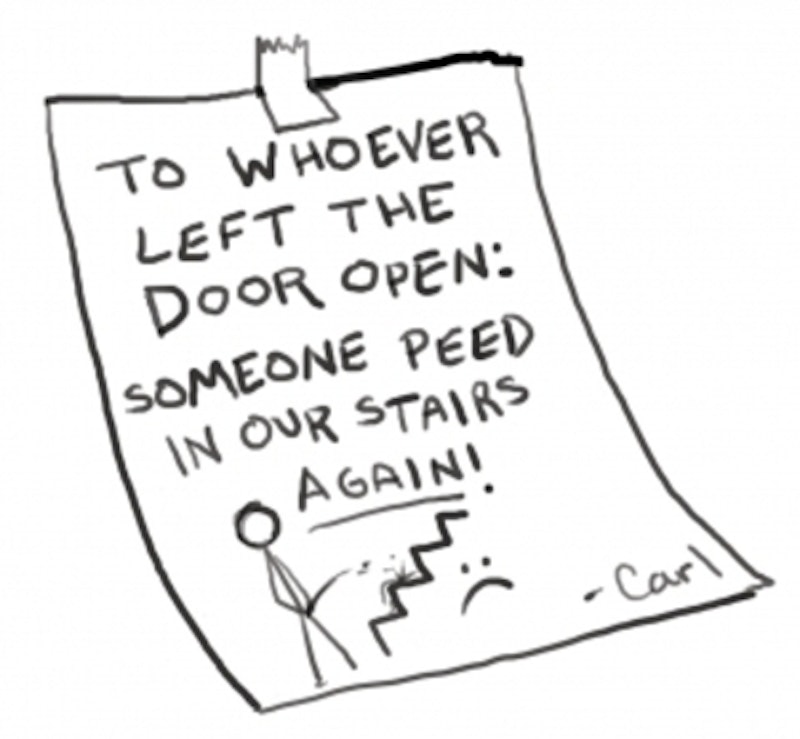
A Guide to Passive-Aggressive Note Writing
Communication is key to any good relationship. In group living, avoiding direct confrontation in order to preserve a thin veneer of civility is just as important. From The McGill Daily.
Ben Peck, The McGill Daily
