
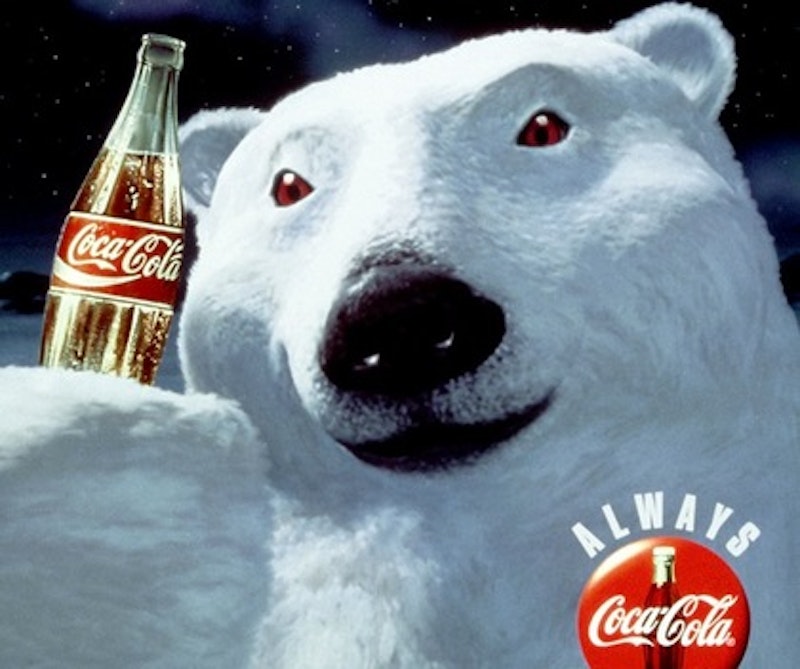
Looking at the recent Michigan snow from the safety of my warm apartment stirs up memories: Getting stranded in New Jersey in the Blizzard of '96; sledding near my great aunt and uncle's home in Vermont; the polar bears of our youth. You know what I mean. Polar bears like this guy. That's right; one of my warmest, most comforting wintertime memories derives from a soft drink advertising campaign launched in 1993.
The early- to mid-90s were halcyon days for marketing-firm-crafted animated friends like those polar bears, Cool Spot , Chester Cheetah, and, of course, Joe Camel. Mr. Camel, or "Old Joe" as he was officially known, is no longer with us, unfortunately. That's what you'd expect when every child knows and loves your mascot, but the product you just happen to sell is a viciously unhealthy and addictive substance-in this case, we're talking, of course, about cigarettes.
No one can fault a company for having a great ad campaign, but there is something a bit insidious about familiarizing children with an addictive substance that could have long-term negative health effects.
Cigarettes aren't the only addictive, unhealthy substance peddled by those childhood friends of mine. Maybe it's time for this country to sit down and really think about soda. I know it's hard because we've had a long relationship with soft drinks, but we ought to reconsider the way we expose our kids to them.
New York's proposed soda tax, while flawed, is a good first step. I agree with Nicholas Kristof's assessment that the proposed tax should help get kids off sugary drinks. An article in the Journal of Public Health Policy, published a little more than eight years ago, found that a 1999 one-dollar tax hike was expected to have decreased American cigarette consumption by upwards of nearly 40 percent. Taxes work, especially at the margins.
I can attest to this. When Maryland-once a cheap alternative to Michigan's expensive tobacco-raised the price of cigarettes by a dollar, it forced me to reconsider my old habit. The tax began on January 1, 2008. I quit smoking exactly a month later, haven't had a cigarette since, and this is no coincidence. On a related note, I had three Diet Cokes today, three yesterday, three the day before that, and so on. I'm not saying that soda is more addictive than nicotine, but it's habit-forming.
All this aside, there is a serious hole in Kristof's-and New York Gov. David Paterson's-thinking about a soda tax. It ignores drinking diet soda, which studies have shown to correlate with worse health than regular soda drinking. Diet soda needs to be a part of a proposed tax.
If we're strictly dealing with the sugary nature of beverages, we should honestly extend the tax to all beverages that contain a large amount of sugar per serving. After all, take a look at the sugar and caloric content of juice. It's not that different from the soft drinks themselves (frustratingly, Coca Cola does not provide the sugar content in that link, but the two-liter Coke in the fridge's nutritional label says it has 27 grams of sugar per 8 ounce serving-which is actually less than some of the juices).
Soda, however, is the beverage that, as Kristof points out, correlates with obesity and diabetes, both officially epidemics in this country. For freedom's sake, we can't go around banning unhealthy food, but there is something that differentiates soda from all the other unhealthy products. It is the line that I would draw in the sand, spreading the tax only to sodas. It is the presence of an addictive stimulant known as caffeine (http://www.springerlink.com/content/wl412194360xj32t/).
Take a look at the top 10 best-selling U.S. sodas in 2007. Eight out of 10 contain caffeine. So here we have beverages that are mostly addictive, as well as cause obesity and diabetes-and that ignores any possible negative effects from the caffeine. Beverages like Sprite and Fanta, the two caffeine-free options in the top 10, are marketed as interchangeable pieces of the soda paradigm. A soda is a soda. That makes caffeine-free sodas just as culpable in the situation, especially given that they produce the same negative health effects and benefit from a market created in part through a reliance on caffeine addiction. If the policies affecting soda consumption left out the caffeine-free options, I would protest but understand because the presence of this addictive chemical is the separating point between soda and something that's just bad for you.
So here's what we need to do. First, establish a tax on all sodas including the diet ones. Start teaching the ill effects of soft drinks in the education system, the way "Cigarettes are bad for you" is hammered into your head as you go through school. The last-and possibly most controversial bit-is a ban on soft drink advertising directed explicitly at children. I'm sorry, polar bears, but while soda may not quite be cigarettes, you need to the go the way of Joe Camel.


